NASA Spacecraft Telemetry Anomaly Detection System
Detecting anomalies in real NASA SMAP & MSL mission data using BiLSTM, XGBoost and Random Forest with 98.77% ROC-AUC.
Project Case Study
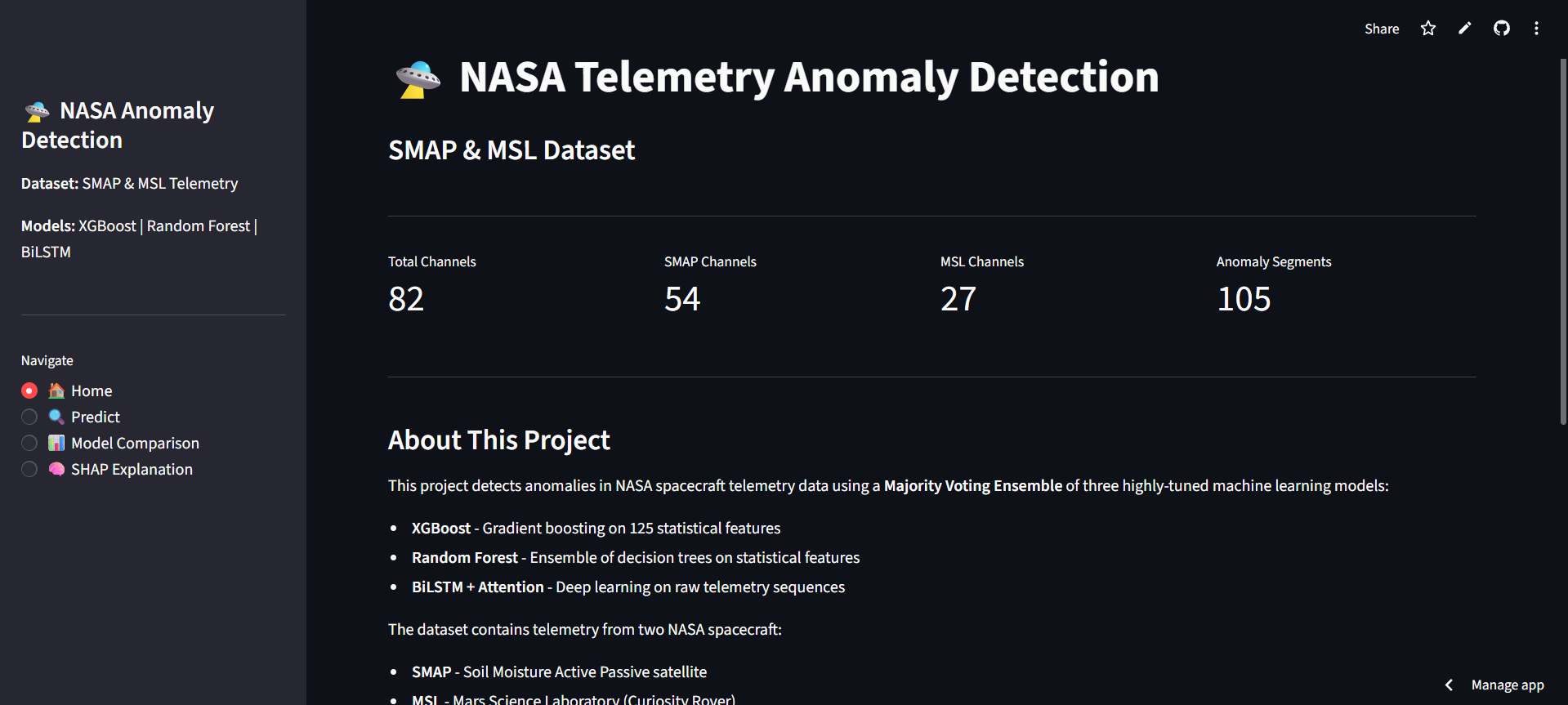
Spacecraft telemetry anomaly detection is a critical challenge in aerospace engineering — undetected anomalies can lead to mission failure or complete spacecraft loss. This project tackles that problem using real NASA telemetry data from two missions — SMAP (Soil Moisture Active Passive satellite) and MSL (Mars Science Laboratory — Curiosity Rover). The dataset contains 82 telemetry channels with 105 labeled anomaly segments and severe class imbalance of only 12.31% anomalies on average.
Key Engineering Milestones
End-to-End Data Pipeline
Complete EDA pipeline analyzing 82 channels, anomaly distributions, temporal patterns and correlation structures. MinMax normalization and sliding window (128 timesteps) conversion of raw time-series into supervised learning format.
Dual Balancing Strategy
GAN-based synthetic anomaly window generation for LSTM pipeline and SMOTE oversampling for ensemble pipeline — tackling severe 12.31% class imbalance head-on.
XGBoost Champion — 98.77% ROC-AUC
Three-model comparison (BiLSTM + Attention, Random Forest, XGBoost). XGBoost with statistical feature extraction (125 features: mean, std, min, max, range per window) achieved 96.21% accuracy and 98.77% ROC-AUC — empirically proving gradient boosting outperforms sequential deep learning for sustained statistical anomalies.
SHAP Explainability + Streamlit Dashboard
TreeSHAP explainability on XGBoost revealing which telemetry channels drive anomaly predictions. Real-time Streamlit dashboard with channel upload, ground truth vs prediction visualization and multi-model comparison.